Sustainability
Sustainability isn't just a buzzword for us — it's the foundation of everything we do. Every pallet we touch is part of our mission to reduce waste, conserve natural resources, and build a circular economy for the wood products industry.
Join Our Green Initiative
Partner with us for sustainable pallet solutions.
Our Environmental Impact
Since 2010, Cleveland Pallet Co. has been tracking and measuring our environmental impact. These numbers represent real, tangible contributions to a healthier planet — and they grow every day.
The Pallet Waste Crisis
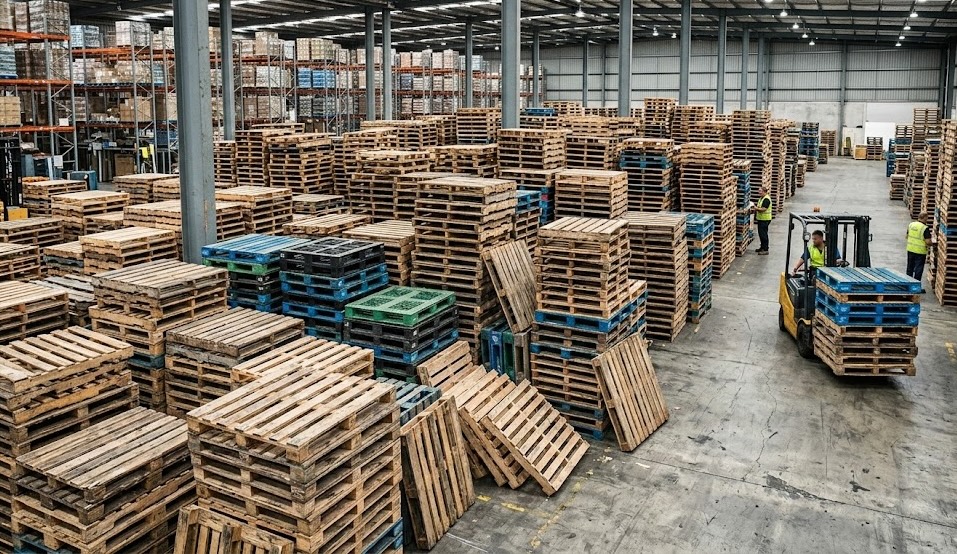
The United States uses approximately 2 billion pallets at any given time, with around 500 million new pallets manufactured every year. Despite their reusability, an estimated 40 million pallets end up in landfills annually.
Pallet waste accounts for roughly 8-10% of all wood waste in U.S. landfills. This represents not just wasted material, but wasted energy — the energy used to harvest timber, mill lumber, manufacture pallets, and transport them to landfills. Each new standard pallet requires approximately 12-15 board feet of lumber, consumes roughly 0.04 cubic meters of roundwood, and generates an estimated 28.5 kg of CO2 equivalent in manufacturing emissions.
The environmental cost extends beyond the landfill. Manufacturing new pallets requires timber harvesting that contributes to deforestation, water usage for lumber processing, and significant energy consumption at sawmills and assembly facilities. The transportation of raw materials and finished pallets adds further to the carbon footprint of every new pallet produced.
At Cleveland Pallet, we're fighting this waste crisis one pallet at a time. Through our comprehensive reuse, repair, and recycling programs, we ensure that virtually every pallet that comes through our facility is given a new purpose. The solution isn't complicated — it just takes commitment, infrastructure, and a willingness to do business differently.
Carbon Footprint Analysis
We track our carbon impact rigorously because reducing emissions requires precise measurement. Here's how pallet reuse translates into real carbon savings.
How We Calculate Carbon Savings
Every pallet we recycle or reuse avoids the carbon emissions associated with manufacturing a new one. Our calculations are based on life cycle assessment (LCA) data from the USDA Forest Products Laboratory and the National Wooden Pallet & Container Association. Key factors include:
Logging, transport of raw timber to sawmill
Kiln drying, cutting, planing of lumber
Assembly, nailing, quality control at pallet factory
Shorter supply chain for reused vs. new pallets
Wood decomposing in landfills produces methane
Annual Carbon Impact Summary
Based on our annual processing of 500,000+ pallets with a reuse rate of approximately 60% and a recycling rate of 38%, we estimate our operations avoid approximately 8,400 metric tons of CO2 equivalent emissions annually. This is comparable to:
Wood vs. Plastic: Environmental Comparison
Both wood and plastic pallets have a role in the supply chain. Understanding their environmental profiles helps you make an informed choice for your business and the planet.
Wood Pallets
Wood pallets are the most environmentally friendly option when sourced from recycled or reconditioned stock. Their natural biodegradability, repairability, and multiple end-of-life recycling options make them the preferred choice for sustainability-focused businesses. Recycled wood pallets have the lowest carbon footprint of any pallet material.
Plastic Pallets
Plastic pallets have a higher upfront environmental cost but offer longer lifespan per unit. They're essential for certain industries (pharmaceuticals, food processing) where hygiene requirements mandate non-porous surfaces. When used in high-rotation closed-loop systems where their long life can be fully utilized, they can be an efficient choice.
Our Recommendation
For most applications, recycled wood pallets offer the best combination of environmental performance and cost efficiency. We recommend plastic pallets only for specialized applications where hygiene, moisture resistance, or extreme durability requirements justify the higher environmental and financial cost. Our team can help you evaluate the right option for your specific use case.
The Pallet Lifecycle
Our comprehensive recycling process ensures that every component of every pallet is given its highest-value use. Nothing goes to waste when it comes through our facility.
Collection & Intake
We collect used pallets from businesses, warehouses, and distribution centers across Northeast Ohio. Our fleet operates daily pickup routes, and we accept pallets in any condition — from lightly used to severely damaged. Each load is weighed, counted, and documented at our intake dock. No pallet is too damaged to accept because even broken pallets contain valuable materials that can be recovered.
Inspection & Grading
Every pallet passes through our multi-point inspection process. Trained inspectors evaluate board condition (cracks, splits, rot), nail and fastener integrity, stringer structural strength, and dimensional accuracy. Pallets are assigned Grade A (premium), Grade B (standard), or Grade C (economy) based on objective criteria. Pallets that don't meet any resale grade are routed to repair or recycling.
Repair & Refurbishment
Pallets with repairable damage are sent to our 8-station repair workshop. Skilled technicians replace cracked or broken boards with new lumber, re-nail loose components, reinforce weakened stringers, and ensure structural integrity meets grade specifications. A single repair typically extends a pallet's usable life by 2-4 additional use cycles, representing significant resource savings compared to manufacturing new.
Resale & Redistribution
Quality-inspected pallets are sorted by size, grade, and type, then staged in our 10,000 sq ft outbound area for efficient order fulfillment. Pallets re-enter the supply chain through sale to businesses across our service area. Every resold pallet directly replaces demand for a newly manufactured one — meaning fewer trees harvested, less energy consumed, and less manufacturing emissions produced.
Wood Recycling
End-of-life pallets that can't be economically repaired are dismantled and processed through our industrial grinder. The resulting wood chips and fibers are channeled to multiple secondary markets: landscape mulch for parks and residential use, animal bedding for equestrian and livestock operations, biomass fuel for energy generation, and raw material for composite wood products.
Metal & Hardware Recovery
Nails, screws, metal banding, and other fasteners are separated from wood during the grinding process using industrial magnets. These metals are collected, sorted, and sold to scrap metal recyclers. Even the smallest nail is recovered — our goal is that absolutely nothing from a pallet reaches a landfill. Metal recovery adds another layer to our comprehensive zero-waste approach.
Where Recycled Materials Go
New vs. Reused Pallets: Environmental Impact
The environmental case for reused pallets is overwhelming. Here's how the numbers compare when you choose recycled over new.
CO2 Emissions
Reusing a pallet avoids the carbon emissions from timber harvesting, sawmill processing, and manufacturing. The only emissions associated with a reused pallet come from transportation and minor inspection/repair activities.
Water Usage
New pallet manufacturing requires water for lumber processing, kiln drying, and facility operations. Reused pallets require virtually no water — just the occasional cleaning for specialty applications.
Timber Consumption
Each new 48x40 pallet requires 12-15 board feet of lumber. Reused pallets consume zero new timber unless they need minor board replacements during repair, which averages just 1-2 board feet.
Energy Consumption
The energy required for logging, sawmill operations, kiln drying, and assembly is significant. Reused pallets only require energy for transportation and minor repair work.
Landfill Space
Pallets that end up in landfills occupy significant space and take years to decompose, generating methane in the process. Every reused pallet is one that never occupies landfill space.
Cost to Business
Beyond environmental savings, reused pallets deliver substantial cost savings. Lower material and processing costs translate directly to better pricing for businesses that choose recycled options.
Annual Sustainability Report Data
We believe in full transparency about our environmental performance. Here's a year-over-year summary of our key sustainability metrics.
| Metric | 2021 | 2022 | 2023 | 2024 |
|---|---|---|---|---|
| Pallets Processed | 385,000 | 420,000 | 465,000 | 510,000 |
| Reuse Rate | 55% | 57% | 59% | 61% |
| Repair Rate | 28% | 29% | 30% | 30% |
| Recycling Rate | 14% | 12% | 9% | 7% |
| Waste Diversion Rate | 96% | 97% | 97.5% | 98% |
| CO2 Avoided (metric tons) | 5,900 | 6,800 | 7,500 | 8,400 |
| Trees Saved | 32,000 | 36,000 | 40,000 | 45,000 |
| Landfill Waste Prevented (tons) | 8,200 | 9,400 | 10,600 | 12,000 |
Community Environmental Programs
Community Mulch Donation Program
Each spring and fall, we donate recycled wood mulch to Cleveland-area parks, community gardens, school grounds, and neighborhood beautification projects. In 2024, we donated over 500 cubic yards of mulch to 35 community organizations. This program turns what would be waste into a valuable resource that enhances green spaces, suppresses weeds, retains soil moisture, and beautifies public areas across our city.
Green Business Mentorship
We share our sustainability expertise with other local businesses looking to reduce their environmental footprint. Through workshops, one-on-one consultations, and facility tours, we help companies in Northeast Ohio implement waste reduction strategies, improve recycling rates, and identify circular economy opportunities within their own operations.
School Environmental Education
Our facility hosts educational tours for K-12 schools and college programs. Students learn about the pallet industry, recycling processes, the circular economy, and career opportunities in environmental services. We've hosted over 40 school groups since launching the program, reaching more than 1,000 students with hands-on sustainability education.
Earth Day Partnership
Each Earth Day, we partner with the Cleveland Metroparks and local environmental organizations for community cleanup and tree planting events. Our team volunteers alongside community members, and we provide mulch and materials for restoration projects. It's one of our team's favorite traditions and a tangible expression of our environmental values.
Estimate Your Carbon Savings
Every business that chooses recycled pallets makes a measurable impact. Here's a quick estimate of the environmental savings based on common order volumes.
1,200 pallets/year
A small warehouse or regional distributor using 100 recycled pallets per month instead of new pallets saves the equivalent of taking 6.6 cars off the road annually.
6,000 pallets/year
A mid-size distribution center or manufacturer switching to recycled pallets achieves the carbon equivalent of planting 2,500 tree seedlings per year.
24,000 pallets/year
A large-scale operation that fully commits to recycled pallets achieves environmental savings equivalent to powering 76 homes with electricity for an entire year.
Our Environmental Certifications & Partnerships
ISPM-15 Certified
The International Standards for Phytosanitary Measures No. 15 (ISPM-15) is an international phytosanitary measure developed by the International Plant Protection Convention (IPPC). Our certification means we can heat-treat wood pallets to the required core temperature of 56 degrees Celsius for 30 minutes, eliminating pests and pathogens. This certification is essential for businesses that ship internationally and ensures their pallets won't be rejected at foreign ports of entry.
NWPCA Member
The National Wooden Pallet & Container Association (NWPCA) is the largest trade organization representing the wood packaging industry in North America. As a member, we adhere to the association's standards for quality, safety, and environmental responsibility. Membership provides us access to industry research, best practice guidelines, and regulatory updates that help us maintain the highest operational standards.
EPA SmartWay Partner
The EPA SmartWay program is a public-private partnership that helps businesses reduce transportation-related emissions. As a SmartWay partner, we commit to measuring and reporting our fleet's fuel consumption and emissions, implementing strategies to improve fuel efficiency, and exploring alternative fuel and vehicle technologies. This partnership aligns with our broader commitment to reducing our operational carbon footprint.
Zero Waste Committed
Our zero-waste commitment means we systematically work to eliminate all waste sent to landfills from our operations. Currently at a 98% waste diversion rate, we're actively pursuing the remaining 2% through process improvements, new recycling partnerships, and materials innovation. We track waste diversion monthly and report annually on our progress toward this ambitious but achievable goal.
Our 2030 Sustainability Roadmap
We're not resting on our achievements. Here are the ambitious sustainability targets we're working toward over the next five years.
100% Renewable Energy
Install a 200kW rooftop solar array to power our facility with clean energy. Expected to offset approximately 40% of our electricity consumption, with plans to reach 100% renewable through a combination of on-site solar and renewable energy credits.
99% Waste Diversion
Close the gap from 98% to 99% waste diversion through new recycling partnerships for hard-to-process materials and process innovations that reduce contamination in our recycled material streams.
100% Waste Diversion
Achieve our ultimate zero-waste goal of 100% landfill diversion. This will require solving the last 1% — typically materials like contaminated wood, certain adhesives, and non-recyclable packaging that currently can't be economically recycled.
Electric Fleet (50%)
Transition at least half of our delivery fleet to electric or alternative-fuel vehicles. We're monitoring the commercial EV market closely and will begin the transition as suitable heavy-duty electric trucks become available and charging infrastructure matures.
Carbon Neutral Operations
Achieve carbon-neutral operations across our entire business — facility, fleet, and supply chain. Through a combination of emission reductions, renewable energy, and high-quality carbon offsets for any remaining emissions, we aim to reach net-zero by the end of the decade.
Want to be part of the solution? Partner with Cleveland Pallet Co. and make your supply chain greener. Every recycled pallet you purchase contributes to a more sustainable future.